Can Agroecology Deliver Higher Yields and Incomes? Evidence from Eastern Burkina Faso
In one of the driest parts of Burkina Faso, farmers adopting agroecological practices in our program areas are seeing higher yields, stronger household incomes and greater resilience to drought. A new economic assessment offers compelling evidence of what farmer-led agroecological transformation can achieve – and raises important questions about where governments should direct agricultural investment.
For more than a decade, farmers in eastern Burkina Faso have been experimenting with agroecological practices, sharing their knowledge and encouraging others to follow suit. In a region where drought, depleted soils and increasingly unpredictable rainfall threaten agricultural livelihoods, this locally driven movement is demonstrating that farmers can improve their production systems while strengthening their ability to withstand difficult conditions without chemicals.
But what does the evidence say about the economic benefits? Can agroecology deliver higher yields and incomes? How does it compare with farming systems reliant on synthetic fertilizers and other chemical inputs? And what will it take to bring these approaches to scale?
These are some of the questions explored in a recent economic assessment conducted by Groundswell International, environmental economist Vanja Westerberg and our Burkinabe partner organization, ANSD. The study examines the economic benefits of agroecological practices among more than 400 farming households in eastern Burkina Faso, looking at agricultural productivity, profitability, household incomes and resilience.
In this episode of The Battle for African Agriculture, hosted by Million Belay, General Coordinator of the Alliance for Food Sovereignty in Africa (AFSA), two guests discuss the study’s findings and the experience behind the research. Bourgou Tsuamba, Groundswell International’s West Africa Regional Coordinator, shares how farmers and local organizations have supported the growth of the agroecology movement in eastern Burkina Faso. Vanja Westerberg explains the study’s methodology and findings, and what they reveal about the economic value of combining agroecological practices.
Their conversation explores the evidence emerging from this work, the barriers farmers face in making the transition, and why farmer organization and changes in public investment matter for bringing agroecology to scale.
Building a farmer-led agroecology movement
This interview has been edited to remove filler words and transcription repetitions.
Million Belay: Let’s start with the history. How did the farmer-led agroecology movement in eastern Burkina Faso begin?
Bourgou Tsuamba: The farmer agroecology movement started more than 10 years ago, when Groundswell International and its partners decided to support farmers and their organizations to set up a sustainable and healthy food system.
As you know, Burkina Faso is a Sahelian country, and the eastern part of the country is among the driest parts. I would say 90% of the area is drought-prone, and the land is depleted because of very low soil fertility, due to climate change but also due to irrelevant farming practices.
Groundswell and its partners decided to identify agroecological innovations that work elsewhere but in a similar environment, and come and try to experiment with the farmers, so that they see what is relevant to their context. If they see it is useful, they can then adopt and spread it at scale.
So this is how it started. Apart from involving farmers in the experimentation, we also made sure that we organized the intervention area in clusters, identifying central villages where people can come and see what is happening and go and implement it in their own area.
Million Belay: Why did you organize farmers to experiment, rather than simply teach them some techniques?
Bourgou Tsuamba: We think that in development, and in developing an agricultural system or food system, there’s not one size fits all strategy that works, because everything is related to the environment where it has been developed.
You need to make sure that what you are doing is relevant to the specific context. We recognize that farmers have their own knowledge and their own context, so we do not think that a top-down approach will work. It’s not workable in our environment. That’s why it’s better to start experimenting at a small scale, pull the lessons and have them scaled out depending on the results. We think it’s far much better to implement bottom-up processes than top-down ones.
Million Belay: You also used farmer-to-farmer learning to help spread agroecological practices. Can you tell me how that happened?
Bourgou Tsuamba: It’s not simple, but not complicated. When people experiment and they see it is useful, we organize farmers to go to the field, where people demonstrate, for field visits, and interact with the farmer and see how the story has unfolded and the results.
Then we encourage every village to select a few people from different neighborhoods to come and be trained on this particular innovation. Those people will go back to their own neighborhoods and also train their neighbors. So it spreads the innovation very fast. That way, you are able to reach the maximum number of people within a very short period, and the costs are very low.
Million Belay: Is that what you call the Agroecology Promotion Committee? Tell me about the two and the importance of this Agroecology Promotion Committee.
Bourgou Tsuamba: The Agroecology Promotion Committees are a kind of community Board, where people come together and coordinate everything related to agroecology in the village.
There are people who have been appointed by the village through a village assembly. They appoint a certain number of people (men, women and youth) to play the role of a Board that will be sensitizing the community about agroecology and also organizing any activity related to agroecology, be it training, field visits or different things.
They are also entitled to go and monitor and see what is happening in the village and motivate people to adopt agroecological work. These committees are a kind of Board to encourage, motivate, organize, monitor and see what is happening.
Million Belay: What is the incentive for doing that?
Bourgou Tsuamba: The motivation is to play a positive role in the village. The farmer trainers are involved in the farmer-to-farmer implementation, and the committee is the one that motivates the community and works with the farmer-to-farmer people to make sure that agroecology is promoted in the village.
Million Belay: They are selected by the community in a very democratic way. I suspect that they include a bigger community representation than farmers alone, maybe government representatives or whatever. Am I right?
Bourgou Tsuamba: In fact, they are more or less farmers alone. But in the process, you have NGOs who come and facilitate the process. Usually, in the case of ANSD, we try to involve government technical services and local government representatives. They come together and do a sort of assessment of how agroecology is evolving in the village.
We discuss with the village the usefulness of having a coordinating board, and then we agree on the criteria, the role and responsibilities of that board, and the criteria for people to meet to be part of the board. Then the village people select people who will play the role.
That committee will now be the interface meaning that the committee will be dialoguing with external people on behalf of the village, promoting agroecology within the village, but also going for advocacy and playing a role in external resource mobilization.
Million Belay: The experience of so many actors is that farmer-to-farmer learning alone will not scale up. You need the government. How do you involve the government?
Bourgou Tsuamba: Absolutely. That’s why, in everything we do, we make sure that the government is on our side.
For instance, before selecting the villages, we inform the government, the local government and the local council. Sometimes they are the ones indicating the most appropriate village to involve in what we are trying to develop.
Then, from time to time, we involve them in doing a tour to see what is happening in the areas following our intervention. Most of the time, they are very happy and committed. That helps them understand what we are doing and respond positively when we come with requests.
As I am talking now, in one of the communities — the district where we intervene — they have agreed to allocate to ANSD a portion of land of more than 10 hectares to implement agroecological work, for farmers to come and learn and for researchers to do different kinds of experimentation.
Our way of doing advocacy is involving decision-makers, including local government. We do not wait to do everything, get good results and then go and plead for them to support us. We make sure that we are travelling together and seeing everything, so that when we come with requests or ask for different things, they are already aware.
We have several situations where they become staff from ANSD or other partners from Groundswell International, and they are promoting agroecology. I remember one of the district heads implemented agroecological work in the compound where he stays. That year, he got more yield than some farmers, and he was proud. Every time we had a meeting, he would come and explain.
Million Belay: What is the role of women and youth? Women and youth are important in most communities. They are very much marginalized. How are you involving both?
Bourgou Tsuamba: Women are vulnerable. I don’t want to use the word marginalized, because for me, saying someone is marginalized means pushing the women to a certain corner of the house. Sometimes you see that even the men are not that better off. But anyway, women and youth have less access to productive means, to knowledge, to money and to different things.
What we do is make sure that everything we do involves both men and women, and that they are all part of the process. When we convene any meeting, we invite men and women equally. When there is a trip, we make sure that we have a quota. A quota means you give a certain number and make sure that number of women is part of the whole thing, so that they are not forgotten.
Besides that, we also make sure that when we do training, the training is decentralized, to come closer to the villages, so that women, who usually don’t have transportation means, can also go, attend and come back to their houses. That way, their husbands and different members of the compound see it as normal, because they will not go and spend several days outside their compound.
Lastly, to make sure that they are also able to implement agroecological work, we do advocacy for them to get land. As you know, land tenure is not easy for women and youth. We cannot make sure that every single woman gets land, but we plead with decision-makers and landlords in different villages to give a portion of land to groups of women to implement what they want to implement.
As I’m talking, in different villages some have two hectares of land, some have half a hectare, some have one and a half hectares, depending on the land availability in the village.
What changes when farmers adopt agroecological practices?
Million Belay: Which practices are farmers in Burkina Faso interested in? Do you experiment with all of them?
Bourgou Tsuamba: The preference in our area is for practices supporting farmers to secure moisture, because we are in drought-prone areas. Everything related to water collection and management is something that people are eager to implement.
That includes zai, half-moons, stone barriers and FMNR. These are the kinds of things that can help collect and keep more water and moisture.
Then you have compost, crop rotation and crop associations. These are more or less the widespread practices in our areas. I never saw a farm where people implement a single agroecological innovation. Usually, it’s a combination of them. The more you combine, the better you get.
Million Belay: What are the changes that farmers have seen in their farms, in terms of soil fertility or livelihoods?
Bourgou Tsuamba: I would say that the crops, depending on the area, when it’s a very barren area, you may get one additional third in terms of crop yields. In some areas, you can double within two or three years. You even find areas where you have two, three and four times more when you compare to farmers who do not do anything regarding agroecology.
I would say in general food security has improved. And even for those who stick to agroecology for several years, it becomes food sovereignty. So it starts from food security to food sovereignty as you continue implementing these things and as you continue being exposed to the discourse in favor of agroecology.
Million Belay: Vanja, what did your economic assessment find about the yields of agroecological farms?
Vanja Westerberg: Very encouraging, and similar to other farming systems I’ve seen where we have regenerative agroecological practices being used.
First and foremost, this is an area where we have farmers doing a mixture of cash and subsistence cropping of sorghum, millet, maize, cowpeas, etc. They are all on an agroecological journey, a journey to adopt agroecology, using between two and 17 practices.
That allows us to see the full spectrum. As you go from monocropping sorghum or maize and start stacking those agroecological practices, how do yields evolve?
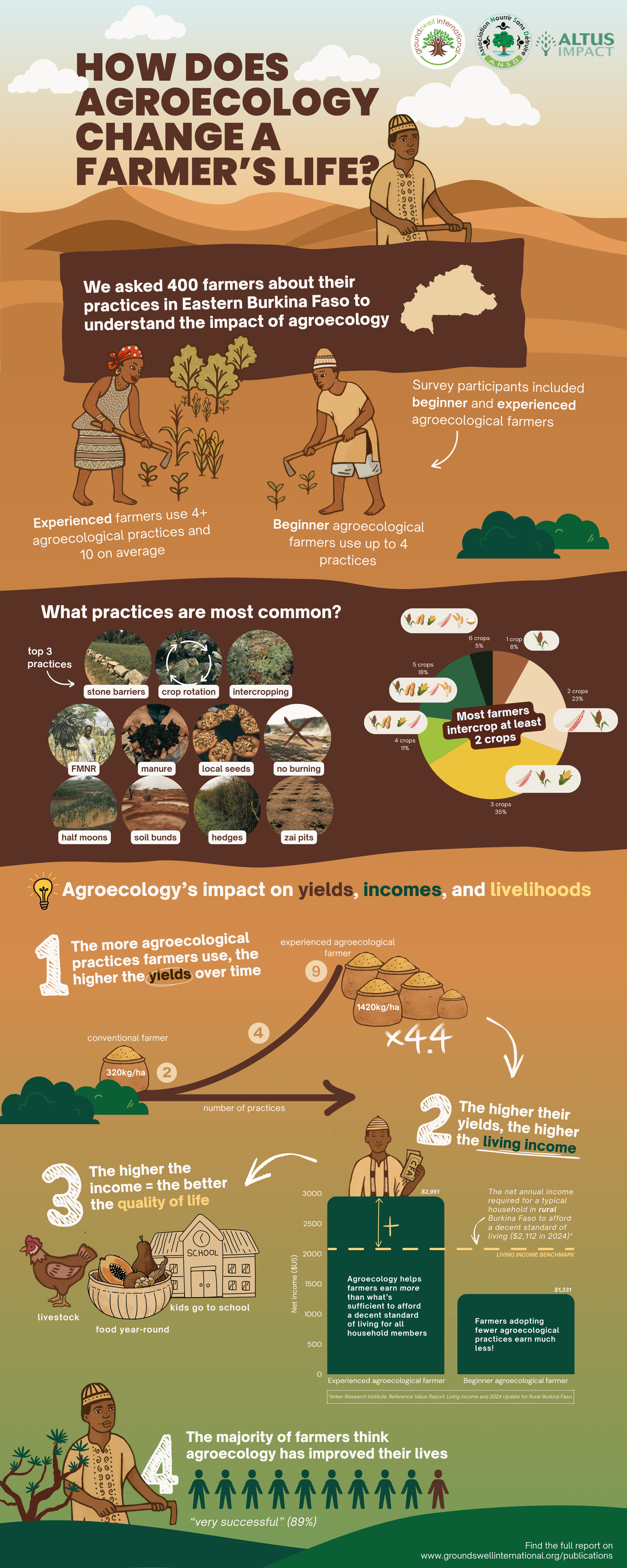
We saw typically that a very basic monocropping farmer who was using one to two agroecological practices had an average yield of 320 kilos per hectare. Then, as they stop burning residues, start associating legumes and cereals, and integrate micro-water catchment zai pits, they go from 320 to about 800–900 kilos of yields.
As tree canopy cover density increases with FMNR practices and low tillage is adopted, we then come to an average of 1,420 kilos.
So basically, you see four times higher yields as you stack the practices.
I should also say that when we’re doing these estimations, we’re using production function modelling. We’re controlling for all other factors that could be influencing these outcomes, so also controlling for the use of pesticides, inorganic fertilizers, literacy and household members.
Million Belay: Have you compared that to conventional agriculture, and those farmers who are using monocrops and artificial fertilizers and pesticides?
Vanja Westerberg: You have to. You can only do that in the area in which you are working.
About one third of the farmers we were interviewing — it was a representative sample of more than 400 farmers in total — were using inorganic fertilizers. We did not find any statistically significant relationship between the use of those inorganic fertilizers and yield.
If you look into agronomic studies, it could perhaps be explained by the fact that soils are already fertile, and fertile soils tend to be more unresponsive to inorganic fertilizers.
For example, in those intensive monocropping systems in Benin that I talked about, I did see a statistically significant correlation between inorganic fertilizer use and yields, but at declining rates.
The question is also not just whether yields are increasing, but at what rate, and whether that increase compensates for the additional cost of those additional units of fertilizer you’re using.
Typically, what I see at best is you get $1 of return for every dollar invested in those inorganic fertilizers, at average levels of use. If you account for the subsidies that went into those fertilizers, societally speaking, you’re making a loss.
Million Belay: And the pollution?
Vanja Westerberg: Of course. And also you’re killing the soil organisms. Soil is a living thing, and there are greenhouse gases. There’s so much involved in what they call true cost accounting.
Even the household finance or the farmer finance hardly justifies it. As mentioned, you have a benefit-cost ratio of one. No one is better off.
But again, you cannot just walk away from that conventional system from one day to the other.
I should also just mention that what we find is that often the agroecological farmers are those that are better off, and so they will usually be applying a bit more fertilizers. But again, we’re not seeing any significant returns.
I’m actually just analyzing a similar dataset from Mali, where I’m finding the same pattern: marginally increasing yields from inorganic fertilizer use that doesn’t really justify what they cost.
Million Belay: What did you find about the ability of agroecological farms to cope with low rainfall?
Vanja Westerberg: The year that we were analyzing was the 2023 harvest, and it was a year characterized by drought and extremely dry conditions, with the median precipitation being below the 5th percentile. That means that only 5% of historical records were drier.
Despite that, these more advanced agroecological farmers were reaping yields in excess of 2,000 kilos per hectare. The average for an advanced agroecological farmer was about 1,200 kilos, whereas those that we put in the category of less advanced, just early starting the transition, had yields in the range of 700 kilos per hectare. So really significant differences in yields, but also considering that it was a very dry year.
Million Belay: What did the study find about net income per hectare?
Vanja Westerberg: Once again, one can hardly talk about agroecological and non-agroecological farmers, because there is this whole spread. Farmers differ in terms of what practices they adopt, how long they have adopted them, and how they combine those practices.
But we managed to define one group that was combining at least four key agroecological practices, including FMNR, zai, low tillage, no residue burning and legume-cereal intercropping. They had at least seven years of experience.
What you can see is that typically these more advanced agroecological farmers also intercrop more crops together. They will be using around eight or nine crops, and typically a maximum of five or six of those intercrops.
For those advanced agroecological farmers, this was the group that adopts at least four or five very key practices: FMNR, low tillage, etc.
They comprised one quarter of the population, 25% of the farmers. As I mentioned, they had higher average yields: 1,200 kilos against 700 kilos for those that are just at the beginning of that transition.
That translates into a higher net income per hectare of $500 per hectare, compared to $300 per hectare for those non-advanced agroecological farmers.
They had doubled their number of livestock, so eight tropical livestock units, and also three times higher income from livestock. The advanced agroecological farmers had double the income from non-timber forest products.
You have this positively reinforcing cycle. Now you have more forage, fodder and biomass, and therefore you can have higher livestock numbers that produce more manure that you provide to your fields. Then your fields — everything kind of compounds.
As a result, you have higher livestock numbers, higher income from livestock and higher income from timber and non-timber forest products.
At the household level, those 25% advanced agroecological farmers had an average annual income of $3,000, compared to $1,330 for the non-advanced agroecological farmers.
Million Belay: What does the evidence tell us about the importance of combining several agroecological practices, including manure?
Vanja Westerberg: Manure is key, but manure is also a result of agroecological practices.
As you adopt more practices, I have the specific numbers here. The relationship is that as the number of agroecological practices increases from one to seven, manure application rates increase from 0.4 tons per hectare to 4.6 tons per hectare.
You can’t separate manure from agroecology, because the agricultural practices allow for more manure to be generated, thanks to more forage, and the trees that will basically trap the manure.
Again, it’s coming back to that positive reinforcing cycle, where manure just becomes an inherent part of the agricultural and agroecological system.
That allows us to debunk the myth that you often see cited: yields in the Sahelian regions are inherently low because of low rainfall and low availability of manure and organic matter. That’s not static. We can increase yields and livestock numbers through agroecological practices. They go together, hand in hand.
Million Belay: One of the principles of agroecology is synergy, and that implies that we include crops, trees and livestock in the farming system. From your experience, what does that change in the farming system?
Bourgou Tsuamba: It changes a lot because it makes the farm resilient.
When you have cattle, trees and agents — I mean labor — it helps a lot because no matter what, whatever the rainy season is, you will still get something to eat.
Compared to conventional farmers, when they are lucky and the rainfall pattern is good, they get full results, saying they have increased the yield. But as Vanja said, it’s not profitable.
During the bad years, that’s when you see the vulnerability of those doing chemicals and other conventional things, because you end up with nothing to eat. I’m exaggerating — I mean low yield, low productivity — but you also have credits to pay back.
While when you are combining innovations, doing synergy and agroecological principles and elements, you have a very low rate of expenditure. You have very low inputs on your farm, and you just need to combine them. You will get healthy food and cheaper production.
I do not see there’s any way for a conventional farmer to compete with an agroecological farmer implementing full agroecology. It’s impossible.
The role of governments in supporting farmer-led agroecology transitions
Million Belay: That’s what the figures from Vanja tell us. So, Vanja, what’s the main economic barrier farmers face during the transition to agroecology?
Vanja Westerberg: I think the main one is labor costs, additional effort.
I’m just looking at some numbers. When we’re making zai pits, 125 by 125, so you have 1,500 zai pits, that requires 78 days of human labor.
Stone barriers that need to be spaced at 50 meters need to be transported and collected. You come to an average cost of $300–350 per hectare.
In the context of a farmer maybe making $400 net income on his main one hectare of land, this is a massive investment cost.
Even for those systems that are low-hanging fruits and low-cost FMNR, you still need basic tools — machetes and rubber boots, sickles — and training, and typically 10 days of effective pruning per hectare.
But that’s a one-time investment.
Million Belay: And then it’s an investment that pays off over time, unlike the conventional system where you have to invest year on year to maintain it.
Vanja Westerberg: That’s why it is profitable when you take a look at it from a several-year time horizon.
But farmers are cash-constrained and also constrained in their labor.
You have some practices, such as legume-cereal intercropping, which will maybe just require that you start harvesting a bit earlier, but then you also enhance food security.
Million Belay: How should governments change agricultural spending if they want agriculture to scale? And what evidence do policymakers still need?
Vanja Westerberg: I think there is a role for subsidies when it comes to farmers doing practices that serve the collective good. These agroecological practices help increase biodiversity, climate resilience and climate change adaptability. If we look at how much is spent — the massive amounts that are spent on inorganic fertilizer subsidies — I’m doing another study on this. Typically, we’re in the order of 0.3 to 0.6% of GDP in many African countries spent on fertilizer subsidies, and also rare resources of foreign reserves.
Again, as we know, it’s not a productive investment because you have to apply them year on year, unlike agroecology, where you make an investment, you make your stone barrier, and it will pay off over 10 years. We find that, for a cost-benefit analysis we did looking at FMNR, zai and stone barriers, you can expect $5 of return for every $1 invested. That’s an annual rate of return of 45%.
These are really impressive economic returns to agroecology.
But if the incentive structures are taking farmers in the way of the conventional system, for various reasons — not just subsidies, but also what the extension service providers say — then those gains cannot be realized.
I think it’s a question of redirecting some of the existing resources that are being spent in farming towards more resilience-building.
Million Belay: What lessons are you getting from Burkina Faso that could be used to motivate the transition to agroecology in other West African countries? And what are the obstacles?
Bourgou Tsuamba: I’ve seen that farmer-to-farmer knowledge sharing, training and experience sharing are things that help things go fast.
We have experimented with that in our network. The farmer-to-farmer strategy started in Burkina Faso, but nowadays all the partners we are working with do the same. Sometimes the name changes, but they do that.
Second, documenting evidence also helps. Vanja has helped us document evidence in Ghana and Burkina Faso, and now she’s doing something like this in Mali. When you share these kinds of results, it helps a lot.
And going to the government, I would say they need evidence, but sometimes — and that’s what I believe — they also need strong, conscious communities willing to implement agroecology and challenge them, engaging them with a very good discourse.
Sometimes I feel that, at least in the past, you may have a minister or even a president wanting to do something good, but there is a lot of pressure on them from different sides. If you have a community that stands for agroecology and is advocating and pushing, it helps. The others that are pushing pressures on the government also see that it will not work.
So yes, we need to have evidence, but I would say we need to have strong, well-organized communities convinced about agroecology, going for the battle for agroecology and engaging the government. Discussing strongly will help a lot.
Vanja Westerberg: I often ask myself: to what extent is it about evidence versus special interests, and getting that evidence across to the right places at the right times?
The only way I can understand these massive amounts that are spent on subsidizing inorganic fertilizer use, given the poor economics, is that there must be some special interests at play that are present at the right meetings, at the right time: West Africa Fertilizer Forum, ECOWAS ministerial round tables, councils of ministers, budget sessions, those workshops before the launch of a new agricultural season.
There is scope for getting in that evidence that agroecology matters.
I think the private sector, the corporate sector with an interest in selling their products, are probably better at being in the right place at the right time, talking with those decision-makers who are deciding where federal funding is being used. So that’s one obstacle. (…)
I think all of us have seen examples where communities got it perfectly right to begin with, until a new policy comes into place, with new incentive structures that take communities on another track. I have so many examples. Every single area I work in, I go and see a policy failure behind it. These policy failures are often well-intended policies, but they have adverse outcomes because they’re not understood.
Hence the importance of the evidence, and getting the evidence across to the right people at the right time and in the right format. Academic articles or publications may not be good enough.
Million Belay: What would success in agroecology look like in West Africa 10 years from now?
Bourgou Tsuamba: I would say seeing agroecological practices scaled out at the territory level, and having local decision-makers supporting agroecological work, including financial support in their local development plans. That’s what I think we’ll see within 10 years or so.
Vanja Westerberg: That farmers have autonomy in decision-making, that they’re eligible for support when they invest in practices that benefit the larger global public goods: climate resilience, biodiversity, rural prosperity, etc.
And that they can therefore also access finance — patient capital at low interest rates, longer loan tenures that reflect this cash flow, which is different for agroecological farming.
As we say, there’s some upfront cost in the first couple of years, but then long-term benefits. So they can access that capital to scale.
We also need a reform of the financial system that could be behind helping and backing these transitions, along with the appropriate policy incentives.
Listen to the full conversation here
Full Impact Study
Policy Brief