Groundswell International’s 2025 Annual Report: How 270,000+ Farmers are Building a Climate-Resilient Future
We are living through a period of converging crises: climate, economic, social, and political. Climate shocks have intensified, food prices and malnutrition are on the rise, conflicts are disrupting millions of livelihoods, and international aid has been slashed. Meanwhile, the industrial food system continues to fuel the climate crisis, concentrate wealth in the hands of a few, lock farmers into dependency on external inputs, and degrade the ecosystems we depend on.
Yet across the world, local communities are building compelling alternatives – systems that strengthen resilience and agency rather than dependence, regenerate ecosystems while improving livelihoods, and expand people’s power to shape their own futures.
When the systems meant to feed the world fail, where do we find solutions?
Growing Through Crisis, Groundswell International’s 2025 annual report, looks to the communities living closest to crisis. Across Latin America and the Caribbean, West Africa and South Asia, smallholder farmers and local organizations are responding to climate shocks, economic instability, and displacement by building farming and food systems that are based on a different set of principles: solidarity, trust, and collective care; the democratization and localization of economic and political power; and working with nature instead of against it.
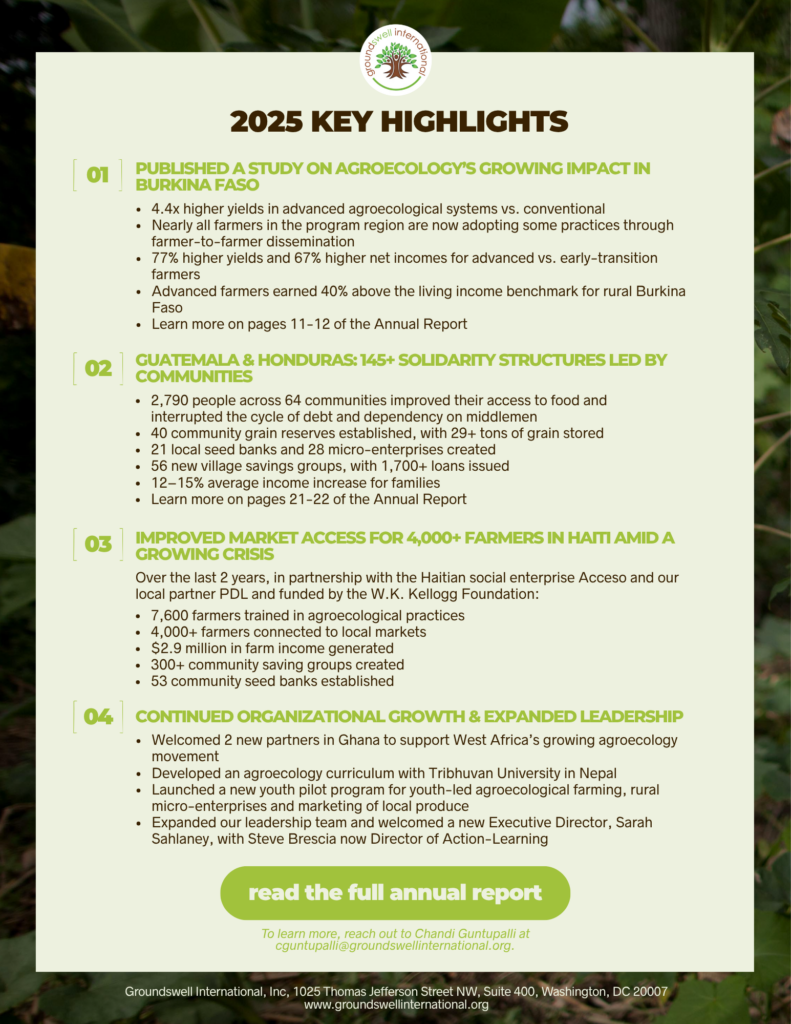
In 2025, Groundswell International and our network of local partners supported more than 273,000 farmers to practice agroecology, contributing to improved livelihoods and wellbeing for over 2.1 million people across 11 countries. Together, communities have been regenerating nearly 241,000 hectares of land while strengthening local food systems, expanding opportunities for women and young people, and building resilience in places facing some of the world’s most severe climate, economic, and social pressures.
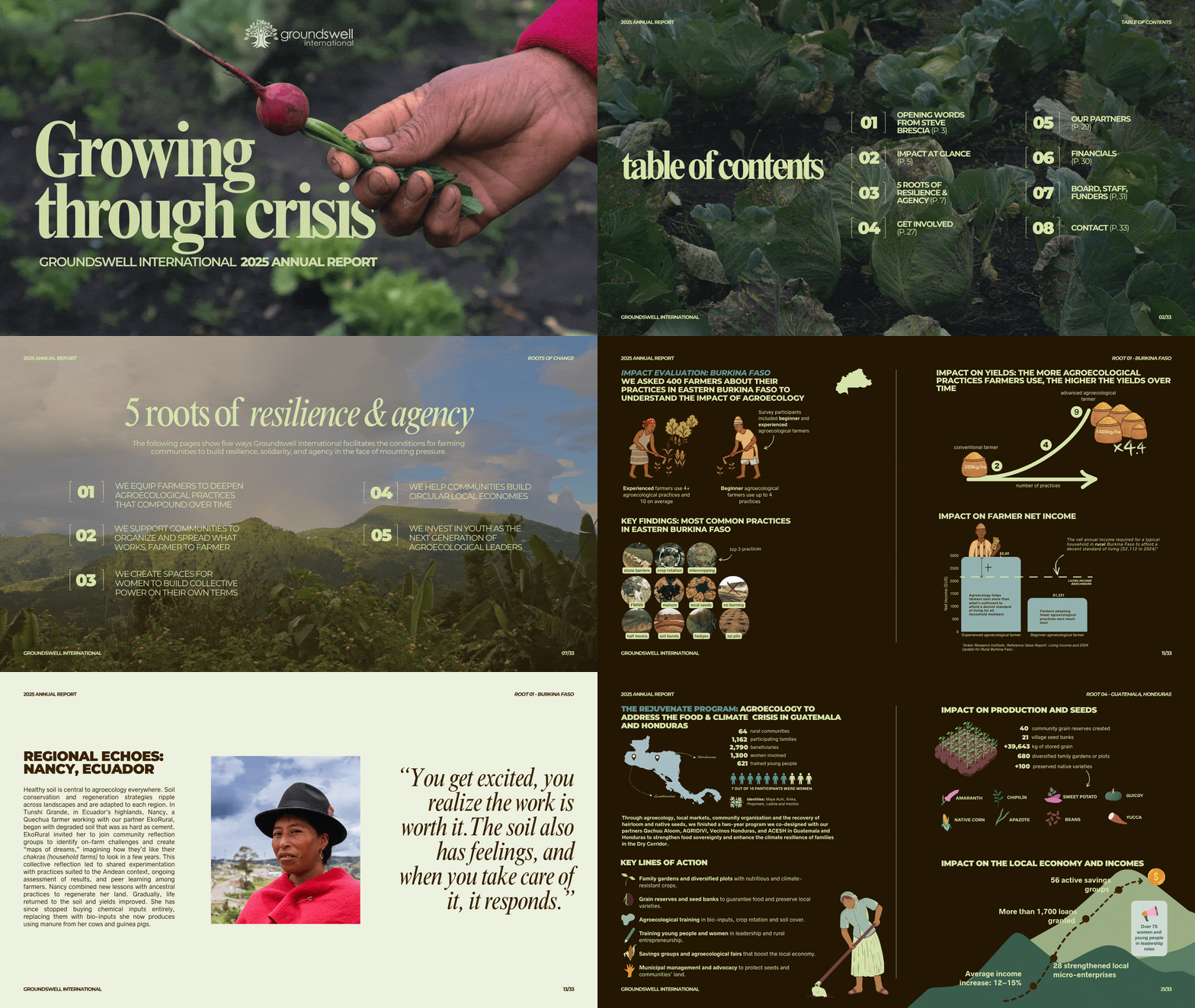
The report explores how these outcomes emerge through five interconnected roots of resilience and agency:
Deepening agroecology to improve yields, incomes, and climate resilience, including new evidence from Burkina Faso showing the long-term benefits of farmer-led agroecological transitions (pages 11-12) – with up to 4.4x higher yields in advanced agroecological systems compared to conventional ones.
Supporting communities to organize and spread innovation, farmer to farmer, through local leadership, collective learning, and community-driven appropriate technology development, reducing some tasks that took a week to a single day.
Creating spaces for women to build collective power and independence, strengthen livelihoods, improve nutrition, and shape the future of their communities, with women forming over 60% of participants in our program.
Helping communities build circular local economies that keep food, seeds, knowledge, and wealth circulating locally rather than flowing outward – with average incomes increasing by 12–15% for participating families in our program areas in Guatemala and Honduras.
Investing in youth leadership so the next generation can carry forward and strengthen the transition toward healthier food systems.
Groundswell International’s role is to help cultivate these conditions through long-term partnerships and sustained co-creation of knowledge and programs with local organizations. By supporting action-learning, resource mobilization, leadership development, and cross-regional exchange, we help communities build fair, regenerative farming and food systems adapted to their local realities, with effects that multiply across borders rather than being limited to a single partner or region.
Growing Through Crisis documents what this path looks like in practice and offers lessons for funders, practitioners, and allies working toward more resilient and equitable food systems.