

The Farmer Who Doubled Her Harvest Without Chemicals in Two Years – Agroecology in Ghana
In northern Ghana, Fuseina spent years watching fertilizer costs rise while her yields fell. Her life took a turn when she joined an Agroecology Committee in 2025, discovering and helping to spread practices that transformed her land.
Written by Salma Abdul-Rashid, Urbanet
Torope, Central Gonja District, Ghana — Fuseina Dokurugu is a 40-year-old smallholder farmer and mother of seven from Torope. She has farmed since childhood, relying on her three-acre plots as her primary source of food and income. Farming was not only her livelihood but also her identity and her hope for securing a better future for her children.
Like many women in her community, Fuseina cultivated maize, soybeans, and groundnuts using conventional chemical fertilizers. She followed the same pattern as her neighbors: buy chemical fertilizer each season, apply it to the fields, and hope for a good harvest. But the pattern stopped working.
Over time, Fuseina noticed a steady decline in soil fertility on her farm. Fertilizer prices continued to rise each season, but her crop yields kept falling. Farming increasingly demanded more financial investment than she could afford, and her household harvests were no longer sufficient to feed the family throughout the year. During the lean season, Fuseina constantly worried about food for her children, school fees, and the uncertainty of the next planting season. Persistent food insecurity, degraded soils, and dependence on costly chemical inputs gradually eroded her motivation and confidence in farming.
Fuseina met with the local NGO UBRANET at a critical time. Curious, committed, proactive, and a fast learner, she fully embraced the agroecological training sessions offered by URBANET. She learned about composting and other practices that strengthen soil fertility.
She was quickly elected organizer of a new community Agroecology Committee that would lead the implementation of appropriate farming tools for agroecological farmers, a project that was started with four partner organizations in Ghana, Burkina Faso, and Mali in 2024.
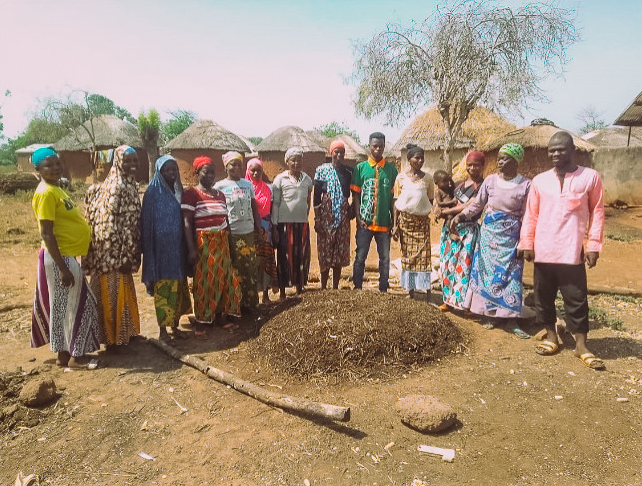
Agroecology Committees are democratically elected groups of 5-7 community members who lead the planning, implementation, and promotion of agroecological practices at the village level. They serve as the community’s official voice on farming matters, representing farmers to local government and organizing collective action to promote and scale agroecology.
The project was designed to identify priority tool needs that fit agroecological systems and smallholder farmers’ realities, test and adapt tools in local contexts, enable small-scale manufacturing, repair, and distribution networks, and document lessons to inform scaling across West Africa.
One of the tools that was introduced was a roller planter. Fuseina quickly became an advocate for its use. Before the roller planter, she shared that planting an acre of groundnut took several days of crouching in the sun using a dibbler or broadcasting seeds. With the roller planter, she now plants in just a few hours, saving time and energy for other farm and household activities.
During harvest, Fuseina also became the first woman farmer in her community to use the groundnut pod stripper provided by URBANET. Previously, harvesting attracted many helpers who took a share of the produce, reducing her final yield. With the pod stripper, she harvested seven bags of groundnuts from an acre, compared to the usual three. She encouraged other farmers to use the machine, highlighting its efficiency and benefits.
Fuseina also embraced compost production using household waste and animal manure, so much that she went on to train other farmers. She trained seven farmers in compost preparation, mulching, and intercropping, using biomass from her own farm. Her success attracted attention beyond Torope, and she was invited to Dakolipe, a nearby community, to facilitate compost training. There, she trained 15 households, reaching about 52 farmers who prepared compost for the next farming season.
After applying compost, Fuseina observed significant improvements on her farm. Her maize cobs grew larger, groundnut pods grew heavier, and the soil grew darker, softer, and more fertile. Yields doubled, enabling her to feed her family year-round, sell surplus produce, and save money for the first time in many years. Household nutrition improved, and her confidence as a farmer grew. She expanded her compost pits, experimented with intercropping, and inspired her husband and neighbors to support and adopt agroecological practices.
Reflecting on her journey, Fuseina shared:
“Before agroecology, I was always afraid of hunger. I spent more on fertilizer but harvested little. Now, I spend less and harvest more. My land is alive again, and so is my hope.”
In recognition of her dedication and achievements, Fuseina was awarded Best Female Agroecology Farmer in the Central Gonja District during the 2025 Farmers’ Day celebrations.

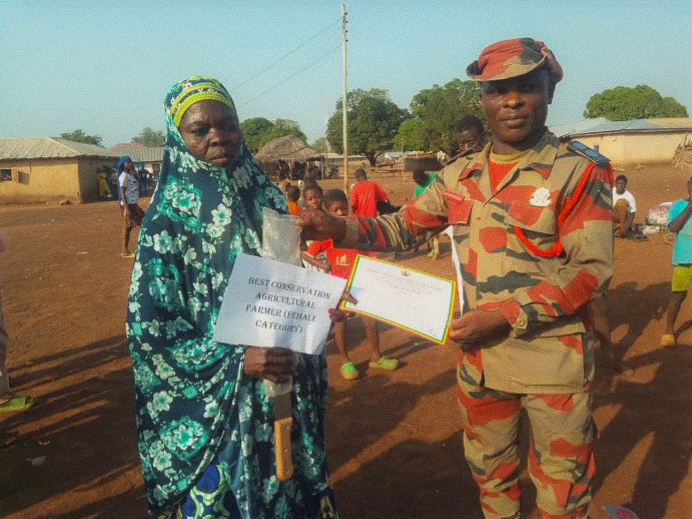
Fuseina has become a role model for women farmers in Torope and surrounding communities. Farmers regularly visit her field to learn about composting, mulching, and intercropping. At community meetings, she shares her experiences and demonstrates compost preparation techniques. As a result, more women are adopting organic manure, diversified cropping systems, and moisture conservation practices.
Her transformation has gone beyond personal empowerment. It has contributed to improved household food security, restored degraded soils, shifted gender norms, and strengthened community resilience to climate change. Fuseina’s story demonstrates that when women gain access to knowledge, skills, and appropriate tools, farms recover, families thrive, and communities begin to change.
She expresses her profound gratitude to URBANET and Groundswell International for the support that transformed her farming journey and her life.
Invest in smallholder farmers to spread real solutions to climate change
Your gift will equip farmers in rural communities across the Global South with the tools, training, and confidence to drive the shift toward regenerative, resilient and equitable food systems, where their voices and solutions lead the way.